
UFC Betting Guide
MMA Wagering Hub: UFC Fight Bets UK
By UFC Betting Analyst
 Available in US
Table of Contents
- Key Factors Shaping Your UK UFC Betting Success
- Why UFC Fight Bets Are Booming in the UK
- How UFC Betting Odds Work: Fractional, Decimal, and American
- Core UFC Bet Types Every Punter Should Know
- Odds & Value Calculator
- Building a Winning Approach: Strategy Fundamentals
- Betting on UFC in the UK: Regulation, Tax, and UKGC Licensing
- How to Choose a UFC Bookmaker in the UK
- Fight Integrity and Betting Safety
- The Paramount+ Era: What It Means for UFC Punters
- Frequently Asked Questions About UFC Fight Bets
- Responsible Gambling
Key Factors Shaping Your UK UFC Betting Success
- The MMA betting market hit $10.3 billion in handle and is growing at 17% annually — UK punters are entering a deep, liquid market with real edges still available in undercard and prop markets.
- Favourites win roughly 65% of UFC fights, but that 35% underdog win rate creates consistent value opportunities when you know which matchup profiles produce upsets.
- All UK betting winnings are tax-free, and every legal bookmaker must hold a UKGC licence — but the 2026 Remote Gaming Duty rise to 40% will reshape which platforms survive and what margins you face.
- Fractional odds remain the UK standard, yet understanding decimal and American formats unlocks sharper implied probability calculations and cross-platform comparisons.
- The Paramount+ broadcast deal eliminated the PPV barrier, pushing UFC viewership past 10 million households and making live betting access easier than ever for UK fight fans.
Nine years of staring at fight odds will change the way you watch a UFC card. I stopped seeing two athletes and started seeing a probability matrix — reach differentials, takedown defence percentages, finish rates by weight class, all filtering through my mind before the cage door even closes. That shift is what separates a fan who throws a tenner on the main event from a punter who consistently extracts value from the octagon.
UFC fight bets have exploded from a niche corner of combat sports into one of the fastest-growing segments of global sports wagering. The MMA betting handle reached $10.3 billion in 2024, growing 17% year-on-year, and that figure only accounts for tracked legal markets. The global sports betting market itself sits at $112.26 billion in 2025 with projections reaching $325.71 billion by 2035. MMA is riding that wave harder than almost any other sport, and the UK is one of the sharpest markets in the world for it.
But here is the thing most guides will not tell you: knowing that a moneyline exists is not an edge. Every punter on the planet can read a betting slip. The edge comes from understanding why heavyweight knockout rates hover around 50% while flyweight decisions dominate, why first-fight winners repeat in 66% of rematches, and why a weight cut that strips a fighter of 15% of their body mass should change your entire approach to the over/under. This guide is built on that kind of data-driven thinking.
I have written this for UK punters specifically — because fractional odds are our native language, because UKGC licensing is our safety net, and because the regulatory landscape shifting under our feet in 2026 demands attention. Whether you are placing your first fight wager or refining a strategy that already turns a profit, every section ahead is grounded in the numbers I track and the patterns I have watched play out across hundreds of UFC events.
Why UFC Fight Bets Are Booming in the UK
I remember trying to find UFC odds at a UK bookmaker in 2017. The main event had a moneyline and maybe — maybe — an over/under line. The rest of the card? Invisible. Fast-forward to a Saturday night in 2026, and I am scrolling through 40+ markets per fight, from exact round finishes to significant strike totals, on platforms that would have laughed at MMA a decade ago. The transformation has been staggering, and it is being driven by forces that are nowhere near finished.
The UK sports betting market generates approximately GBP 2.48 billion in annual Gross Gambling Yield, and MMA’s share of that pot keeps climbing. The UFC itself is valued at $1.74 billion in 2026, with projections pushing toward $2.79 billion by 2033 at an 8% compound annual growth rate. Those are not speculative numbers from a startup — that is an organisation that generated over $1.1 billion in revenue across the first nine months of 2025 alone, backed by a parent company trading on public markets.
The global MMA betting handle reached $10.3 billion in 2024 — a 17% increase on the previous year. To put that in perspective, a decade ago the entire combat sports betting category barely registered as a line item on most sportsbook revenue reports.
What is fuelling it? Three converging forces. First, the Paramount+ broadcast deal worth $7.7 billion over seven years — roughly $1.1 billion annually — doubled UFC’s previous media revenue and eliminated the pay-per-view barrier that kept casual fans away from main cards. Second, the sportsbook partnerships. DraftKings’ $350 million agreement in 2021 was not just a sponsorship — it fundamentally changed the data infrastructure available for UFC markets. As DraftKings’ co-founder Jason Robins put it, combat sports has been “evolving from a niche offering to a high-demand category” that the industry expects will only grow as platforms innovate around it. Third, the demographic shift. The UFC’s new broadcast home is attracting a significantly younger audience that stays engaged beyond fight nights — which tells you this is not a flash in the pan but a structural expansion of the sport’s fanbase and, by extension, its betting markets.
UK Sports Betting GGY
Approximately GBP 2.48 billion annually
Global UFC Market Value
$1.74 billion in 2026, projected $2.79 billion by 2033
MMA Betting Handle
$10.3 billion in 2024 with 17% year-on-year growth
Paramount+ Deal
$7.7 billion over 7 years, replacing the PPV model

The Mixed Martial Arts Group noted in a recent SEC filing that as the UFC reaches larger mainstream audiences through major broadcast partnerships, fan growth and awareness of martial arts continues to surge — and historically, that visibility translates directly into increased participation across every related market, betting included. I have watched that pattern repeat across three consecutive broadcast deals now. Each time the UFC becomes easier to watch, the betting markets get deeper, the lines get sharper, and the opportunities for informed punters multiply.
For UK-based bettors, the timing is particularly interesting. The total remote gambling sector in this country hit GBP 7.8 billion in Gross Gambling Yield for the period April 2024 to March 2025 — a 13.1% jump on the previous year. Combine that with a sport whose audience skews young, digitally native, and hungry for data-driven engagement, and you start to understand why every major UKGC-licensed operator now treats UFC as a priority market rather than an afterthought.
How UFC Betting Odds Work: Fractional, Decimal, and American
A punter I know once passed on a UFC fight because the odds “looked too complicated.” He was staring at American moneyline numbers on a US-facing site and did not realise the same fight sat at a perfectly readable 4/1 on his UK bookmaker. That single moment of confusion cost him a winner at cracking odds. Understanding how odds work across all three major formats is not academic — it is the difference between spotting value and scrolling past it.
In the UK, UFC betting odds explained in fractional format remain the default on most UKGC-licensed platforms, though nearly every site now lets you toggle between formats. The leading UK bookmakers carry margins of around 4% on major UFC fights, which is competitive by combat sports standards and means the odds you see are reasonably close to true implied probabilities — but only if you know how to read them.
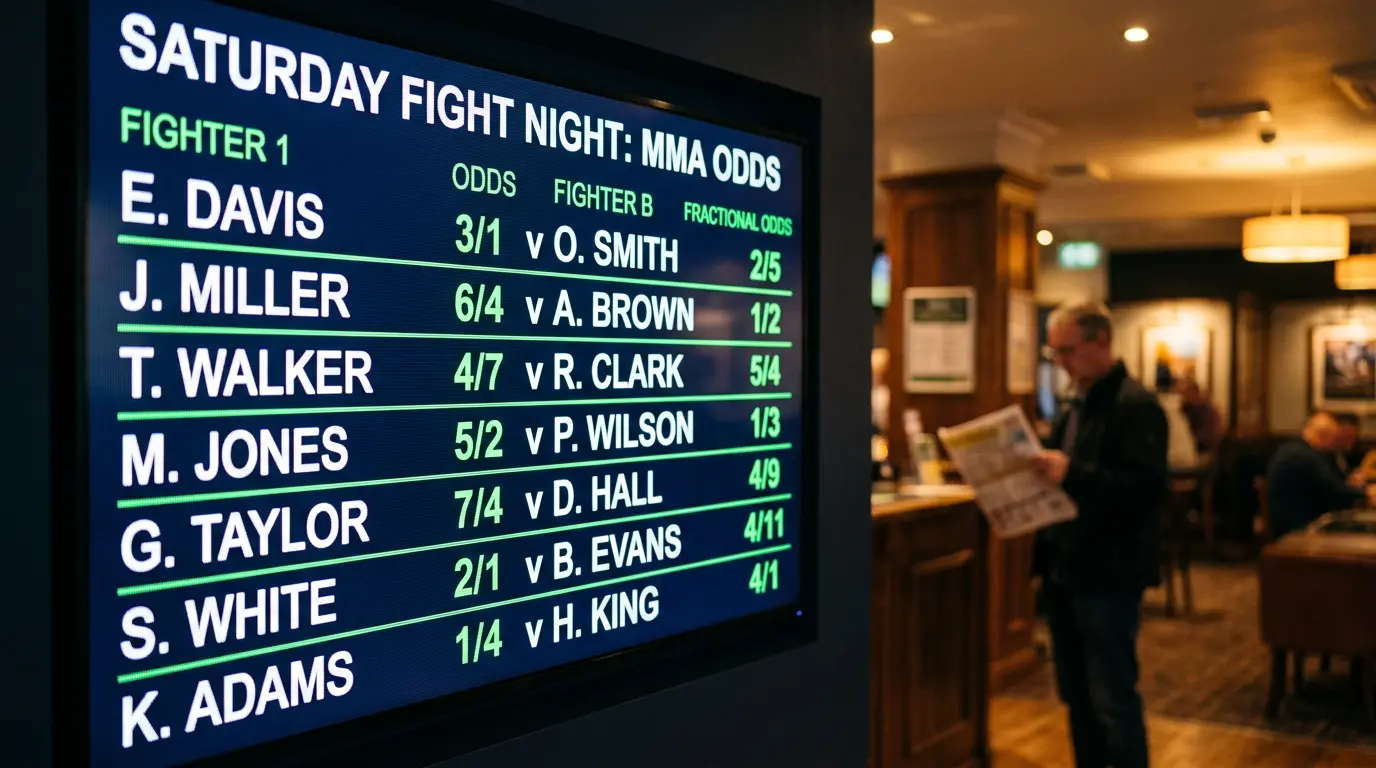
Fractional Odds — the traditional UK format, expressed as a fraction (e.g., 3/1). The first number represents potential profit relative to the second number, which is your stake. A GBP 10 bet at 3/1 returns GBP 40 total (GBP 30 profit plus your GBP 10 stake).
Decimal Odds — the European standard, widely used on exchanges and increasingly popular in the UK. A decimal odd of 4.00 means every GBP 1 staked returns GBP 4.00 total. Decimal odds always include your stake in the figure, which makes comparing across markets faster.
American (Moneyline) Odds — the US format you will encounter on sites like DraftKings coverage and US-oriented tipster content. Positive numbers (+300) show profit on a $100 stake. Negative numbers (-150) show how much you must stake to win $100. Useful to know when reading American MMA analysis, but rarely the format you will bet in from the UK.
The Same Fight, Three Formats
Illustrative example — odds are hypothetical to show how the same prices appear across formats.
| Format | Fighter A (Favourite) | Fighter B (Underdog) |
|---|---|---|
| Fractional | 2/5 | 7/4 |
| Decimal | 1.40 | 2.75 |
| American | -250 | +175 |
The conversion between formats is mechanical once you understand the logic. Fractional to decimal: divide the fraction, add 1. So 7/4 becomes 1.75 + 1 = 2.75. Decimal to implied probability: divide 1 by the decimal odd. So 1.40 translates to 1 / 1.40 = 71.4% implied probability. The bookmaker’s margin — the overround — means both fighters’ implied probabilities will sum to more than 100%. When I see a two-fighter market summing to 104%, I know I am looking at roughly a 4% margin, which is standard for a UK-licensed operator on a headline UFC fight.
When comparing UFC odds across bookmakers, always convert to the same format first. A fighter at 6/4 fractional, 2.50 decimal, and +150 American is the same price — but spotting a discrepancy between one bookmaker offering 6/4 and another offering 13/8 (which is 2.63 decimal) is much easier when both prices sit in the same format. Most experienced punters default to decimal for comparison because the maths is simpler.
Where this matters practically: if you are reading a US-based UFC breakdown and they quote a fighter at -180, you need to instantly translate that to roughly 9/5 fractional or 1.56 decimal to evaluate whether your UK bookmaker is offering better or worse value. I keep a mental shortcut for the most common lines — anything between -150 and -200 American sits in the 1/2 to 2/5 fractional range, which is heavy favourite territory. Anything above +200 American is 2/1 or longer in fractional — underdog territory where the genuine value tends to live in MMA.
Core UFC Bet Types Every Punter Should Know
Walk into any UKGC-licensed sportsbook’s UFC section and you will find a dizzying wall of markets. The first time I saw a full fight card with method-round combination bets, fighter specials, and distance props alongside the basic moneyline, I felt like I had walked into a sweet shop with no prices on anything. The trick is knowing which shelves to reach for — and more importantly, which ones to walk past. Every UFC bet type carries different margins, different edges, and different levels of analytical depth required to beat the line.
Moneyline
Pick the winner. The simplest and most liquid UFC market.
Method of Victory
KO/TKO, submission, or decision. Demands knowledge of fighter styles.
Over/Under Rounds
Will the fight last beyond a set number of rounds? Finish rate data is your edge.
Odds & Value Calculator
Implied probability is the chance the price is “pricing in”. Your job as a punter is to find fights where you rate a fighter higher than the implied figure.
Underdogs win roughly 35% of UFC fights — every leg you stack multiplies that upset risk. Decimal combined odds = each leg multiplied together.
Edge = your win % minus the fair (no-vig) figure. Suggested stake uses quarter-Kelly, capped at 3% of bankroll — discipline beats hunches.
Moneyline (Fight Winner)
The moneyline is where most punters start and where many stay permanently — and there is nothing wrong with that. You pick the fighter you believe will win, full stop. No method, no round, no exotic conditions. The payout reflects the perceived probability gap between the two fighters.
Here is what makes moneyline betting in MMA uniquely interesting compared to, say, football or tennis: underdogs win roughly 35% of UFC fights. That figure alone should reshape how you approach every single card. In most established sports, the favourite wins at much higher rates, which compresses the value available on the underdog side. In MMA, a 35% upset rate means backing underdogs at the right price is not a lottery ticket strategy — it is a mathematically viable approach.
Moneyline Calculation: Fractional Odds
Illustrative example with hypothetical odds.
Suppose Fighter A is priced at 1/3 (fractional) and Fighter B at 5/2.
A GBP 30 bet on Fighter A at 1/3: Profit = 30 x (1/3) = GBP 10. Total return = GBP 40.
A GBP 10 bet on Fighter B at 5/2: Profit = 10 x (5/2) = GBP 25. Total return = GBP 35.
Fighter A’s implied probability: 1 / (1 + 0.333) = 75%. Fighter B’s implied probability: 1 / (1 + 2.5) = 28.6%. Combined: 103.6% — the 3.6% excess is the bookmaker’s margin.
Method of Victory
This market asks you to predict not just who wins, but how. The typical categories are KO/TKO, submission, and decision — though some bookmakers split it further into KO/TKO per fighter, submission per fighter, and decision.
Heavyweight fights end by knockout approximately 50% of the time, and nearly two out of three finish before the final bell. Below welterweight, no division carries a KO rate above 30%. This single data point should fundamentally change which method-of-victory bets you consider depending on the weight class.
Method of victory is where stylistic analysis starts paying dividends. A wrestler facing a striker in the lightweight division creates a very different probability distribution than two knockout artists meeting at heavyweight. I treat method-of-victory markets as my primary “edge” market because the bookmaker’s lines tend to react slower to stylistic mismatches than to headline name recognition.
Over/Under Rounds
The over/under on total rounds is set by the bookmaker — typically at 1.5 or 2.5 for a three-round fight, and 2.5 or 3.5 for a five-round championship bout. You bet whether the fight will last longer (over) or shorter (under) than that line.
Over/Under Example: Three-Round Fight
Illustrative example — odds are hypothetical.
| Market | Fractional | Decimal |
|---|---|---|
| Over 1.5 Rounds | 4/7 | 1.57 |
| Under 1.5 Rounds | 11/8 | 2.38 |
Weight-class data transforms this market from a coin flip into an informed wager. In women’s bantamweight, fights have gone over 1.5 rounds in 27 out of 28 cases since 2020 — a 96% hit rate. That is not a trend; that is a structural feature of the division driven by the skill profiles and physical attributes of the fighters competing there. Identifying these division-specific patterns is the fastest route to consistent returns on round totals.
Understanding the markets is the foundation. But knowing which bet to place is only half the equation — the other half is knowing when a line is wrong and how to exploit it systematically.
Building a Winning Approach: Strategy Fundamentals
I blew my first UFC bankroll in three events. Not because I picked badly — I actually hit more winners than losers — but because I sized my bets like a maniac, loading up on heavy favourites and ignoring the mathematical reality that a 65% win rate for favourites means you will eat losses on roughly one in three fights no matter how sharp your analysis is. Strategy is not about being right more often. It is about being right in the right amounts at the right prices.
The UFC betting strategy that has sustained my returns over nine years rests on a few principles that might sound boring compared to “insider tips” or “lock of the night” culture, but they work precisely because they are boring. Boring is profitable. Exciting is expensive.
As I covered in the moneyline section, underdogs take roughly 35% of UFC fights. That number bears repeating here because it is the single most important input for your staking strategy. A 35% upset rate is massive compared to tennis or basketball. It means parlays built on stacking heavy favourites will collapse more often than your gut tells you, and it means underdog value is structurally available on nearly every card if you know where to look.
One of the sharpest edges I have found sits in rematch data. First-fight winners go on to win the rematch 66% of the time — a record of 52 wins against 26 losses across UFC history. That is a powerful baseline when you are evaluating a rematch card. It does not mean you blindly back the original winner, but it does mean the burden of evidence falls on anyone arguing the loser has genuinely closed the gap. UFC’s Chief Operating Officer Lawrence Epstein has spoken about how more robust data generation from UFC events feeds directly into gaming markets — and rematch data is a prime example of information that sits in plain sight yet gets underweighted by recreational bettors.
Do
- Check weight-class finish rates before selecting your bet type — heavyweight KOs and flyweight decisions are structural, not random
- Size your stakes according to your edge, not your excitement level
- Track your bets rigorously with a spreadsheet recording odds, stake, result, and ROI
- Compare odds across at least three UKGC-licensed bookmakers before placing
- Focus on underdogs in the +150 to +300 range where implied probabilities most often diverge from actual win rates
Don’t
- Stack heavy favourites in parlays and assume the accumulator is “safe” — a 35% upset rate per leg compounds brutally
- Chase losses by increasing stakes after a bad card
- Bet on every fight on a card — if you do not have an edge, you do not have a bet
- Ignore fighter changes (new camps, layoffs, weight class moves) because the historical record is strong
- Treat UFC like a predictable sport — the variance is the feature, not the bug

Pre-Bet Checklist: Run Through This Before Every Wager
- Have I checked the weight-class finish rate data for this division?
- Have I compared odds across at least three UK bookmakers?
- Is my stake within my unit-sizing rules (typically 1-3% of bankroll)?
- Do I have a specific, articulable reason for this bet beyond “he looks good”?
- Have I checked for late news — weight misses, injury reports, camp changes?
- Am I betting this fight because I have an edge, or because I want action?
The most common mistake I see among UFC punters is treating the sport like football. In football, the form book and league tables create relatively stable probabilities. In MMA, a single punch changes everything. Your strategy needs to account for that volatility at every level — bet selection, stake sizing, and emotional discipline after losses.
Betting on UFC in the UK: Regulation, Tax, and UKGC Licensing
A friend of mine used an offshore sportsbook for years because the odds were marginally better on UFC fights. Then his account was frozen during a withdrawal dispute, and he discovered that “marginally better odds” meant “no regulator to complain to.” He lost GBP 2,400 sitting in limbo with no recourse. I tell that story not to scare anyone but to make a point that should be non-negotiable: if you are betting from the UK, you bet with UKGC-licensed UFC betting sites. Everything else is risk without compensation.
The UK Gambling Commission licenses and regulates every legal online betting operator serving British punters. The total remote gambling sector — covering casino, sports betting, and bingo — generated GBP 7.8 billion in Gross Gambling Yield for the period April 2024 to March 2025, a 13.1% increase on the previous year. That scale means UKGC-licensed platforms are among the most heavily regulated and well-capitalised in the world.
All UK betting winnings are completely tax-free for the punter. You pay no income tax, no capital gains tax, and have no obligation to report gambling profits to HMRC. The tax burden sits entirely with the operator through the Remote Gaming Duty.
That tax-free status is a structural advantage that UK punters sometimes take for granted. In many US states, gambling winnings above certain thresholds are taxable income. In the UK, whether you win GBP 50 or GBP 50,000 from a UFC bet, every penny is yours.
The regulatory picture is shifting in 2026, however, and every serious UFC bettor should understand what is coming. The Remote Gaming Duty — the tax operators pay on their UK revenue — rises from 21% to 40% from 1 April 2026. That is not a minor adjustment; it is nearly doubling the tax burden on every bookmaker serving UK customers. Industry analysis suggests more than 800 UK operators across casino and betting could close by 2027 as a result of this and other regulatory pressures.
What does the Remote Gaming Duty rise mean for punters? Operators will likely absorb some of the cost by widening their margins — which means slightly worse odds for you. It also means smaller operators with thinner margins may exit the UFC market entirely, reducing competition. Fewer bookmakers competing for your custom typically means less price pressure and fewer promotional offers.
The practical takeaway is straightforward: stick to UKGC-licensed platforms, understand that your winnings are tax-free, and watch the operator landscape carefully over the next 12 to 18 months. The bookmakers that survive the duty rise will be the ones with the deepest pockets and the most efficient operations — which, for punters, tends to mean tighter margins and better technology. The shakeout may actually benefit informed bettors in the medium term, even if the short-term adjustment stings.
How to Choose a UFC Bookmaker in the UK
Not all bookmakers treat UFC the same way. I have had accounts with platforms that list 50 markets on a heavyweight title fight but offer nothing beyond a moneyline on Fight Night prelims. I have seen others with razor-thin margins on main events but bloated overrounds on props that turn a fair bet into a losing proposition. The bookmaker you choose is itself a bet — and it deserves the same analytical rigour you apply to the fights.
UKGC Licence
Non-negotiable. Confirms operator compliance with UK law, fund segregation, and dispute resolution access.
MMA Market Depth
Check coverage across full cards — main events, prelims, and Fight Night events. Depth beyond moneyline matters.
Margin (Overround)
The best UK operators carry roughly 4% on headline UFC fights. Anything above 6% on a main event is uncompetitive.
Live Betting and Streaming
In-play UFC markets are growing fast — 53.4% of all online betting activity is now live. A platform with live streaming and real-time odds is a material advantage.
The UK’s largest bookmakers — names you will recognise from football and horse racing — now all offer UFC markets. The leading operators in terms of MMA market depth tend to carry margins around 4% on major fights and provide features like live streaming that let you watch and bet simultaneously. Flutter Entertainment, the parent company behind several major UK-facing brands, reported revenue of $15.91 billion for 2025, up 17% on the previous year, with EBITDA of $2.85 billion. That financial scale matters because it means these operators can afford to keep UFC margins competitive even as the Remote Gaming Duty rises.
| Criteria | What to Look For | Red Flag |
|---|---|---|
| Market Range | Moneyline, method, rounds, props, specials on full cards | Only moneyline on non-main events |
| Odds Competitiveness | Overround under 5% on main events | Overround above 7% consistently |
| Live/In-Play | Round-by-round markets with real-time updates | No in-play UFC offering at all |
| Cash Out | Full and partial cash out available on UFC singles | Cash out disabled for combat sports |
| Payment Speed | E-wallet withdrawals within 24 hours | Withdrawal processing beyond 72 hours routinely |

One thing I have learned from years of platform-hopping: do not marry a bookmaker. The smart approach is maintaining active accounts with three or four UKGC-licensed operators and shopping the best price on each fight. A quarter-point improvement on your odds does not feel significant on a single bet, but across 200 bets a year it compounds into a meaningful difference in your overall return.
Fight Integrity and Betting Safety
In November 2025, a fight on the UFC Vegas 110 card between Dulgarian and Del Valle triggered something no punter wants to see: suspicious betting patterns flagged by integrity monitors, an FBI investigation launched, and two major sportsbooks voiding all wagers and returning stakes. The fighter involved was released from the UFC. Two months later, a scheduled bout between Johnson and Hernandez was pulled from the UFC 324 card before it even took place, after the gaming integrity service IC360 flagged irregular betting activity. Dana White did not mince words about that decision — he said he got the call from the integrity service and immediately pulled the fight, refusing to repeat what happened in Vegas.
UFC signed a partnership with U.S. Integrity (now IC360) in January 2023 and added a second monitoring agreement with ProhiBet in September 2023. Every UFC fight — from the first prelim to the main event — is monitored for irregular betting patterns in real time. When flags are raised, fights are pulled and investigations follow.
White has been characteristically blunt about the consequences facing anyone who attempts to manipulate fight outcomes, publicly warning that the organisation will pursue fighters with the FBI and “do everything we can to make sure you go to prison.” That is not corporate boilerplate — the two incidents in late 2025 and early 2026 demonstrate the monitoring infrastructure actually works, which is reassuring for punters whose money sits on these outcomes.
For UK bettors, the practical implications are clear. When a fight is voided due to integrity concerns, UKGC-licensed bookmakers typically return all stakes as void bets. Your accumulator legs involving that fight will be settled without the affected selection, reducing the overall odds but not wiping out the slip entirely. The system is not perfect — it is reactive by nature, catching suspicious patterns after bets are placed rather than preventing manipulation before it happens. But the combination of real-time monitoring, rapid response, and genuine consequences for offenders makes UFC one of the more actively policed betting environments in combat sports.
What should you watch for? Sudden, sharp line movements on undercard fights — particularly when the movement contradicts the publicly available analysis. If a prelim fighter who should be a 3/1 underdog suddenly drifts to even money with no news to explain it, that is the kind of signal the integrity services are also watching. I do not suggest you play detective, but being aware of these dynamics helps you avoid inadvertently betting into a compromised market.
The Paramount+ Era: What It Means for UFC Punters
For years, the biggest obstacle to betting UFC intelligently was the simplest one: you could not watch the fights. Pay-per-view meant shelling out GBP 20 to GBP 25 per event, and if you were not willing to pay, you were betting blind on the main card while relying on Twitter updates. That era is over. The UFC’s seven-year media deal with Paramount, worth $7.7 billion — roughly $1.1 billion annually and double the previous ESPN arrangement — fundamentally changed the economics of being a UFC punter.
Paramount reported that over 10 million households watched more than 100 million hours of UFC programming on their platform, delivering viewership more than 15 times the average pay-per-view event over the previous two years. That is not a modest increase in accessibility — it is an entirely different scale of audience.

Why does a broadcast deal matter for your bets? Three reasons. First, UFC live betting only works if you can actually see the fight in real time. Betting in-play on a fight you are following through a text commentary feed is like driving blindfolded — you might survive, but your edge evaporates entirely. The Paramount+ deal means most UFC events are now accessible through a single subscription rather than individual PPV purchases, making live betting viable for a much wider pool of UK punters.
Second, the audience expansion is deepening the betting markets themselves. More viewers means more bettors, which means more liquidity in the odds, which means tighter lines and more efficient markets on main events. For sharp punters, this actually pushes the value toward the prelims and undercard fights where the broader audience is not paying attention — a dynamic I have been exploiting increasingly over the past 18 months.
Third, the demographic shift matters. Paramount noted that new UFC subscribers skew 15 years younger than the average platform viewer, and they are engaging with content beyond just the fights. A younger, digitally native audience is more likely to bet on mobile, more comfortable with in-play markets, and more open to prop bets and bet builder features. The bookmakers are responding by deepening their UFC market offerings specifically to capture this audience — which gives experienced punters more surface area to find mispriced lines.
The PPV era created a natural ceiling on how many people could seriously engage with UFC betting. That ceiling has been removed. Whether that is a net positive for your returns depends entirely on whether you are the one bringing analysis to a market that is suddenly full of casual money.
Frequently Asked Questions About UFC Fight Bets
How do UFC betting odds work in the UK?
UFC odds in the UK are typically displayed in fractional format, the same way you would see odds on horse racing or football. A fighter listed at 3/1 means you win GBP 3 for every GBP 1 staked, plus your stake back. A fighter at 1/4 means you need to stake GBP 4 to win GBP 1. Most UK bookmakers also let you switch to decimal or American formats in your account settings. The key skill is calculating implied probability from the odds — divide 1 by the decimal equivalent to see the bookmaker’s estimated win percentage for each fighter. Any gap between that implied probability and your own assessment is where value lives.
What types of bets can you place on UFC fights?
The core markets on most UKGC-licensed bookmakers include moneyline (picking the winner), method of victory (KO/TKO, submission, or decision), over/under total rounds, exact round finish, and fight to go the distance. Beyond these, you will find prop bets on significant strikes, takedowns, and knockdowns, as well as accumulator and bet builder options that let you combine multiple selections from the same fight. Title fights and main events typically offer the deepest market selection, while prelim fights may be limited to moneyline and basic totals.
Is it legal to bet on UFC in the United Kingdom?
Yes, entirely legal. UFC betting is fully regulated under the Gambling Act and overseen by the UK Gambling Commission. Any operator offering UFC markets to UK customers must hold a valid UKGC licence, which requires compliance with responsible gambling measures, fund segregation, and fair terms. Unlicensed or offshore operators should be avoided — they fall outside UKGC jurisdiction, which means you have no recourse if something goes wrong with your account or a disputed bet.
What happens to my bet if a UFC fight is cancelled?
If a fight is cancelled before it starts — whether due to injury, weight miss, or integrity concerns — UKGC-licensed bookmakers typically void the bet and return your stake in full. For accumulators, the voided leg is removed and the remaining selections are settled at adjusted odds. If a fight starts but is stopped due to an accidental foul and declared a no contest, most bookmakers also void the bet, though specific rules can vary between operators. Always check the individual bookmaker’s combat sports settlement rules, as there are minor differences in how edge cases like majority draws or technical decisions are handled.
Can you bet on UFC fights live (in-play)?
Yes, and live betting has become one of the fastest-growing segments of UFC wagering. In-play betting now accounts for over 53% of all online betting activity globally, and UFC is particularly well-suited to it because the breaks between rounds create natural betting windows. Most major UKGC-licensed bookmakers offer in-play UFC markets including live moneyline, next round finish, and method of victory. The key requirement is being able to watch the fight in real time — betting in-play without visual access eliminates almost any analytical edge you might have.
Are UFC betting winnings taxed in the UK?
No. All gambling winnings in the UK are completely tax-free for the bettor. You do not pay income tax, capital gains tax, or any other levy on your UFC betting profits, regardless of the amount. The tax obligation falls on the operator through the Remote Gaming Duty, which is set to rise from 21% to 40% in April 2026. This operator-side tax may indirectly affect you through slightly wider margins, but your actual winnings remain untouched by HMRC.
What is the best type of bet for UFC beginners?
The moneyline — simply picking the fight winner — is the best starting point. It requires the least technical knowledge, carries the lowest bookmaker margins, and lets you focus on the most fundamental question in combat sports: who wins this fight? Once you are comfortable with moneyline betting and have developed a feel for reading odds and assessing fighter matchups, method of victory is the natural next step. Avoid parlays and exotic props until you have a tracked record of consistent returns on singles — complexity does not equal profitability, and simpler bets are easier to evaluate and learn from.
Responsible Gambling
Gambling should be entertainment, not income. If you find yourself chasing losses, betting more than you can afford, or feeling anxious about your wagering activity, stop and use the tools available to you.
Every UKGC-licensed bookmaker is required to offer deposit limits, loss limits, session time reminders, and self-exclusion options. Use them proactively — setting a deposit limit before you start betting is not a sign of weakness, it is a sign of discipline. The same analytical mindset that helps you find value in a fight card should tell you that no edge is worth risking money you cannot afford to lose.
GamStop is the UK’s national self-exclusion scheme. Registering with GamStop blocks you from all UKGC-licensed gambling sites for a period of your choosing — six months, one year, or five years. If you or someone you know needs support, the National Gambling Helpline is available on 0808 8020 133, free and confidential, 24 hours a day. GamCare and BeGambleAware also provide resources, counselling, and practical tools for anyone affected by problem gambling. None of the strategies or data in this guide are worth anything if they come at the cost of your wellbeing.
Created by the ”ufc Fight Bets” editorial team.